Introduction to Ultrasonic Flow Meter Technology
Ultrasonic flow meters have revolutionized flow measurement in industrial applications by providing accurate, non-invasive measurement capabilities. Unlike traditional flow meters that require mechanical elements in contact with the fluid, ultrasonic meters use sound waves to measure flow velocity, eliminating pressure drop, wear, and maintenance issues associated with invasive measurement methods. This comprehensive guide explores the principles, applications, and selection criteria for ultrasonic flow meter technology.
The non-invasive nature of ultrasonic flow measurement makes these instruments ideal for applications where fluid contamination must be avoided, where abrasive or corrosive fluids would damage conventional meters, or where installation without process shutdown is required. Modern ultrasonic flow meters achieve accuracy levels comparable to or exceeding traditional technologies while offering significant advantages in installation flexibility and maintenance requirements.
Operating Principles
Transit-Time Method
Transit-time ultrasonic flow meters measure the difference in time taken for ultrasonic pulses to travel upstream versus downstream. When ultrasonic pulses travel in the direction of flow, they move faster than when traveling against the flow. This time difference, typically measured in nanoseconds, is proportional to the flow velocity. Transit-time flow meters provide excellent accuracy for clean liquids and are widely used in water treatment, HVAC, and chemical processing applications.
The transit-time method requires that the fluid be relatively clean, as particles or bubbles can scatter the ultrasonic signals. For optimal performance, the fluid should have less than 1% suspended solids or gas bubbles by volume. Transit-time meters are available in both clamp-on and wetted configurations, with clamp-on versions allowing installation without penetrating the pipe wall.
Doppler Method
Doppler ultrasonic flow meters rely on particles or bubbles in the fluid to reflect ultrasonic signals. The frequency shift of the reflected signal, known as the Doppler shift, is proportional to the velocity of the reflecting particles and thus the fluid velocity. Doppler meters are ideal for applications involving dirty liquids, slurries, or aerated fluids where transit-time meters cannot function effectively.
The Doppler method requires a minimum concentration of reflectors in the fluid, typically at least 100 ppm of particles larger than 30 microns. Applications include wastewater, mining slurries, pulp and paper processes, and other challenging fluid conditions that would quickly damage mechanical flow meters.
Types of Ultrasonic Flow Meters
Clamp-On Flow Meters
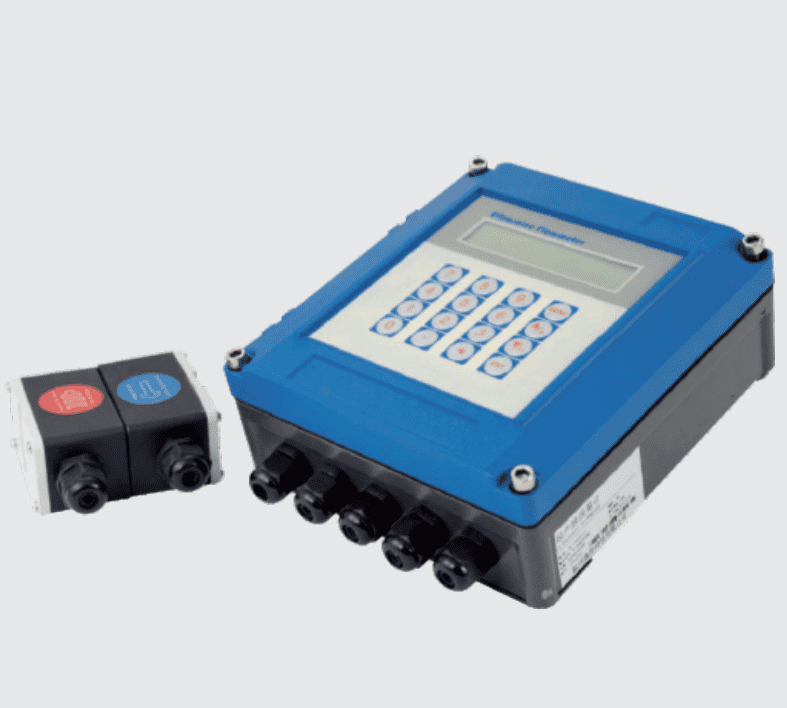
Clamp-on ultrasonic flow meters mount externally on the pipe surface, with transducers coupling to the pipe through acoustic coupling gel or permanent adhesive. This non-invasive installation offers several advantages: no process shutdown required for installation, no pressure drop, no risk of leakage, and compatibility with any pipe material that conducts sound effectively. Clamp-on meters are particularly valuable for retrofitting existing systems or temporary flow measurement applications.
Insertion Flow Meters
Insertion ultrasonic flow meters have transducers that penetrate the pipe wall but do not extend across the full pipe diameter. These meters provide better acoustic coupling than clamp-on versions and are less affected by pipe wall conditions. Installation requires a small opening in the pipe, but the minimal intrusion reduces pressure drop and maintenance compared to full-bore meters.
Inline Flow Meters
Inline ultrasonic flow meters incorporate the transducers into a spool piece that becomes part of the piping system. This configuration provides the best acoustic coupling and highest accuracy, making inline meters the preferred choice for custody transfer and other high-accuracy applications. The wetted transducer surfaces are typically made from materials compatible with a wide range of process fluids.
Applications Across Industries
Water and Wastewater
Municipal water systems extensively use ultrasonic flow meters for distribution network monitoring, leak detection, and consumption measurement. The non-invasive nature of clamp-on meters allows installation without service interruption, while the absence of moving parts ensures long-term reliability without maintenance. Wastewater applications benefit from Doppler-type meters that handle the suspended solids and gases common in sewage and industrial effluent.
Oil and Gas
The petroleum industry uses ultrasonic flow meters for wellhead measurement, pipeline monitoring, and custody transfer applications. Multi-path ultrasonic meters achieve the high accuracy required for custody transfer while handling the wide range of fluid properties encountered in oil and gas production. Compatibility with corrosive fluids and ability to measure bi-directional flow make ultrasonic meters well-suited for this industry.
Chemical Processing
Chemical plants benefit from ultrasonic flow measurement for aggressive fluids that would damage mechanical meters. Non-invasive designs eliminate seal and bearing failures that plague conventional meters in corrosive service. The ability to measure flow without process penetration reduces leak potential, important for hazardous and expensive chemicals.
HVAC and Building Services
Heating, ventilation, and air conditioning systems use ultrasonic flow meters for chilled water, hot water, and condenser water measurement. The bidirectional measurement capability supports variable flow systems, while the minimal pressure drop reduces pumping energy consumption. Energy management applications combine flow measurement with temperature sensing for BTU metering.
Selection Criteria
Fluid Properties
Understanding fluid properties is essential for proper meter selection. The speed of sound in the fluid, acoustic attenuation, and the presence of particles or bubbles all affect ultrasonic meter performance. Clean, clear liquids favor transit-time meters, while dirty or aerated fluids require Doppler-type instruments. Temperature and pressure ranges must also be considered for proper transducer and housing selection.
Accuracy Requirements
Accuracy specifications for ultrasonic flow meters typically range from ±0.5% to ±2% of reading, depending on meter type and application conditions. Custody transfer applications demand the highest accuracy, typically achieved with multi-path inline meters. Process control applications may accept somewhat lower accuracy in exchange for installation flexibility and lower cost.
Installation Conditions
Proper installation is critical for ultrasonic meter performance. Sufficient straight pipe length upstream and downstream of the meter ensures fully developed flow profiles required for accurate measurement. The general recommendation calls for at least 10-20 diameters of straight pipe upstream and 5 diameters downstream, though specific requirements vary with pipe configuration and meter type.
Transducer positioning must account for pipe material, wall thickness, and diameter. Clamp-on meters require knowledge of pipe wall condition and may not work well with corroded, lined, or uneven pipe surfaces. Proper acoustic coupling is essential for reliable signal transmission.
Common Mistakes When Selecting an Ultrasonic Flow Meter
Ignoring Pipe Conditions
Incorrect pipe material or wall thickness may affect ultrasonic signal transmission.
Choosing the Wrong Measurement Technology
Transit-time and Doppler technologies are designed for different fluid conditions.
Neglecting Installation Location
Poor installation location may cause unstable readings due to turbulence or insufficient straight pipe length.
Ignoring Fluid Conditions
Temperature, pressure, bubbles, and particles should be considered before selection.
Calibration and Verification
Ultrasonic flow meters require initial calibration to establish the relationship between measured transit time or frequency shift and actual flow rate. Factory calibration in controlled conditions provides baseline accuracy, while field verification confirms proper installation and operation. Advanced meters incorporate self-diagnostic features that monitor signal quality and alert operators to potential problems.
Periodic verification using portable reference meters or volumetric methods confirms continued accuracy. The stability of ultrasonic meter calibration typically exceeds that of mechanical meters, with recalibration intervals of several years common in benign applications.
Advanced Features
Modern ultrasonic flow meters incorporate sophisticated electronics that enhance measurement capabilities. Digital signal processing improves accuracy in challenging conditions by filtering noise and optimizing signal detection. Multiple measurement paths provide better velocity profile integration for higher accuracy and tolerance of flow profile distortion.
Communication capabilities including HART, Modbus, and wireless protocols enable integration with plant control systems and remote monitoring applications. Self-diagnostic features monitor transducer performance, signal strength, and fluid quality, providing early warning of developing problems before they affect measurement accuracy.
Conclusion
Ultrasonic flow meter technology offers compelling advantages for industrial flow measurement, combining non-invasive installation, high accuracy, and minimal maintenance requirements. Understanding the operating principles, application requirements, and selection criteria enables engineers to specify ultrasonic meters that deliver reliable performance across diverse industrial applications. As digital signal processing continues advancing, ultrasonic flow measurement capabilities will expand further, solidifying the technology’s position as a preferred solution for modern flow measurement challenges.